



Active or Passive Investing? – Why the Smartest Portfolios Use Both
 Killian Nolan
11.02.2026
Active or Passive Investing? - Why the Smartest Portfolios Use Both
Active or Passive Investing?- Why the Smartest Portfolios Use Both
For years, the investment story has sounded simple: passive funds are cheaper, easier and therefore better. That is true in part, but incomplete. Passive funds are easy to access and low-cost, but relying on them alone can overlook how markets really work, how risks evolve and how investors actually experience returns. The real question for investors is not active or passive. It is what mix of the two gives them the best chance of reaching their financial goals.
Markets Are Not Always Efficient and That Creates Opportunity
Passive investing assumes markets are broadly efficient. History shows otherwise. Periods of dislocation, bubbles, regime shifts and behavioural extremes regularly emerge. during these moments, the gap between winners and losers widens sharply. In these environments, skilled active managers such as Cantor Fitzgerald Asset Managers Europe (CFAM) can help investors protect capital and capture opportunities that passive strategies must simply follow. Over multiple market cycles, the gap between the best and worst companies has widened rather than narrowed. Passive funds, by design, own all of them. Active management allows investors to avoid businesses where fundamentals no longer justify valuations.
Index Construction Is Not Neutral
One of the least discussed realities of investing is that indices are not objective reflections of the economy. They are rules-based portfolios with built-in biases, including:
- Momentum bias, where companies that have already risen receive larger weights
- Sector concentration, with today’s indices dominated by a small number of mega-cap technology stocks
- Backward-looking composition, reflecting yesterday’s winners rather than tomorrow’s leaders
Passive investors accept these biases automatically. Active strategies allow investors to challenge them.
The Definition of Biggest Changes Dramatically Over Time
| 2005 | 2015 | 2025 |
| Exxon | Apple | Apple |
| GE | Exxon | Nvidia |
| Microsoft | Microsoft | Microsoft |
| Citi | Alphabet | Amazon |
| BP | Wells Fargo | Alphabet |
| J&J | J&J | Meta |
| Pfizer | GE | Broadcom |
| Bank of America | JP Morgan | Tesla |
| HSBC | Nestlé | Taiwan Semi |
| Vodafone | Novartis | JP Morgan |
Source: Bloomberg, CFAM
The companies that dominate markets change meaningfully over time. What once defined market leadership is rarely what defines it in the future.
This evolution highlights three important truths for investors:
- Passive portfolios overweight what has already performed well
- They underweight areas of future growth as innovation reshapes the global economy
- While the future cannot be predicted, it will not look like the past
Risk Management Requires More Than Tracking an Index
Passive funds offer limited protection during market downturns or structural shifts. They follow indices wherever they go, regardless of valuation or concentration risk. Active strategies allow portfolios to adjust exposures, manage risk dynamically and reduce reliance on areas where fundamentals weaken.
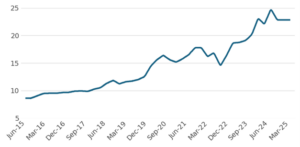
With a small group of stocks now representing a significant share of global indices, a reversal in sentiment could have an outsized impact on investors relying solely on index-based strategies. Market concentration has increased substantially. In both 2005 and 2015, the top ten companies represented around 10 percent of the market. By 2026, that figure has risen to approximately 25 percent.
Weight of Top 10 Stocks in Global Market
Source: Bloomberg, CFAM
Cost Matters but So Does Value
Costs are one of the few variables investors can control, and they matter. However, focusing on cost alone tells only half the story. Cost is one side of the equation. Value added is the other. For investors, a skilled active manager who consistently outperforms net of fees is not expensive. They are valuable. Over long time horizons, even modest excess returns can compound into meaningful differences in financial outcomes.
The Most Effective Portfolios Blend Both Approaches
The most sophisticated investors, including pension funds, endowments and sovereign wealth funds, rarely choose between active and passive strategies. They combine them deliberately:
- Passive strategies for efficient, well-researched markets
- Active strategies for less efficient areas where skill can add value
- Active approaches for risk management and capital preservation
- Passive exposure for low-cost market access
This approach is not ideological. It is pragmatic.
Clients Deserve More Than a One-Size-Fits-All Solution
Every investor has different goals, time horizons and risk tolerances. Relying solely on passive funds can reduce investing to a cost-minimisation exercise. While simple, this approach is not always appropriate. Active management introduces flexibility, judgement and the ability to respond to changing market conditions, qualities that matter to investors with real financial objectives.
Conclusion: Move Beyond the Binary Debate
Passive investing works. Active investing works. The strongest portfolios use both. Investors should move beyond the idea that they must choose one approach over the other. The key question is which combination of strategies offers the highest probability of long-term success. High-quality active managers remain essential. When combined thoughtfully with passive strategies, they help create portfolios that manage risk, capture opportunity and deliver better long-term outcomes.
Written by Killian Nolan – Director of Intermediary Distribution