



CFAM H2 Market Review and Outlook
 Philip Byrne
08.07.2026
CFAM H2 Market Review and Outlook - The Biggest Bet in History
AI is now the biggest bet in history. Entering the second half of the year, the funds are positioned for a very volatile period as rate hikes meet euphoric, exuberant and artificial intelligence-driven expectations.
Despite the strong performance in global markets to start 2026, we believe our low-risk, low-beta portfolio is the prudent approach. The funds lagged their benchmarks in H1 2026 after semiconductors led a near-record-breaking rally in risk assets in Q2. We used this strength in AI-related names to fully reduce our exposure to AI technology and anything in the AI supply chain. Global indices were dragged higher by this euphoria, which we feel is unsustainable and is now reaching alarming levels. The earnings upgrades seen year to date in the US are undoubtedly impressive but are also increasingly concentrated in one part of one subsector of the market: AI semiconductors. The quality of earnings overall is worrying. The circular nature of the financing of AI capex is now leading to circular earnings upgrades, as the hyperscalers are marking their holdings in private AI companies to market at higher valuations while simultaneously funding them.
The competitive and capital-intensive nature of this unprecedented buildout continues to drive financing costs higher, increasing the need for evidence of material, sustainable and immediate ROI across the entire value chain. Capital requirements continue to rise. Alphabet has just announced an $80 billion equity raise ahead of some of the largest IPOs in history, all of which are AI-related. Debt issuance across the AI value chain also continues to accelerate at an unprecedented pace. Newly issued AI-related debt is expected to reach $500 billion this year, a colossal figure for a nascent technology in a single year. Yet, to support market expectations for investment through to 2030, issuance would need to continue growing year on year. For context, US government net issuance this year is approximately $1.5 trillion.
The sustainability of this multi-year bull run relies on a trajectory of AI spending, borrowing, building and power consumption that, by any historical standard, appears unsustainable. This spending is falling on a small number of companies whose share prices are not rewarding them for doing so. Microsoft has underperformed the market by close to 50%. Even if this level of investment ultimately generates sufficient long-term returns, incumbent management teams may not live to see them given this degree of share price underperformance. Initially, spending increased as companies expanded their plans. More recently, spending has been driven by rising costs as the supply chain has seized up, with memory costs being the most high-profile example of the quarter. This places further pressure on ROIC. The technology supply chain is under such pressure that we are now seeing real-world inflationary impacts play out in real time. Apple increased prices across its entire product range by $200, fuelling inflationary pressures in the US. The economy is not overheating as much as parts of it are now burning as a result of the unsustainable trajectory of AI spending.
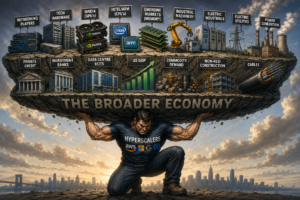
Hyperscalers under pressure – Image generated by AI
Inflation is beginning to rise noticeably, marking a clear break higher in what had been a downward trend since the summer of 2022. The number of rate hikes priced in is slowly increasing, with two now expected in both the UK and Europe. All cuts have been priced out in the US and the language from Fed governors has recently turned noticeably hawkish. Governor Warsh’s opening press conference marked a significant change in how the Fed will interact with markets. Removing forward guidance when inflation is above trend and rising will increase overall volatility. For a generation, markets have relied on a Fed put. Under Warsh, it would appear the strike price is much lower, if there is one at all. The welcome cessation of violence in the Middle East has not been enough to remove the inflationary impacts of the crisis, with the balance of risks still pointing towards higher oil prices over the medium term. We note that gasoline remains up 50% versus its pre-crisis levels.
Regardless of what central banks do, the long end of the bond market has continued to trend higher, a development that could materially affect risk appetite in the short term as issues such as the relative value of equities and debt sustainability return to the forefront. Warsh’s desire to shrink the Fed’s balance sheet also appears to have gone largely under the radar. Liquidity is such a large driver of modern market returns and, traditionally, any threat to it has been met with increased market volatility.
Current US economic growth and stock market returns rely heavily on AI spending being maintained. June produced some interesting data points in this regard. The emergence of open-source, more efficient models appeared to gain credibility as Microsoft indicated a willingness to offer them to customers. Any unexpected pricing pressure on frontier models such as OpenAI and Anthropic could jeopardise the pace of the buildout, as 50% of hyperscaler backlog is tied to these two private companies, where rapid exponential growth is anticipated.
At the same time, OpenAI implied that it would delay its IPO until next year. This delay appears inconsistent with such lofty expectations.
We continue to maintain a low level of risk and beta, but we did make some changes to the portfolios during the quarter. We reduced all of our exposure to the AI infrastructure buildout, replacing it with undervalued, higher-quality names that have lagged and now offer compelling value across US healthcare, financials and software. Our main sector overweight positions are energy, utilities and banks. These sectors should benefit from an environment of elevated and rising commodity prices and interest rates. Technology remains our largest underweight. The record-breaking rally in semiconductors has only been matched once in history, in March 2000, and has been accompanied by the highest level of leveraged retail exposure on record. Whatever one’s positive long-term views on AI as a foundational technology, now does not appear to be the time to express them through investment positioning. It is imperative not to confuse a belief in AI as a transformational technology of the future with AI stocks being a transformational investment opportunity in the present.
We also reduced the duration of the bond portfolio. Persistently rising inflation and increasing rate-hike expectations have resulted in a worrying level of correlation between bonds and equities.
Written by Phil Byrne, CIO, Cantor Fitzgerald Asset Management