



Markets in Transition: Navigating Geopolitics, Rotation and Opportunity
 John Mullane
29.04.2026
Markets in Transition: Navigating Geopolitics, Rotation and Opportunity
The first quarter of 2026 unfolded against a backdrop of escalating geopolitical tensions across parts of the Middle East and Latin America alongside meaningful rotation within financial markets. This rotation reflected, in part, productivity‑enhancing technological disruption that pressurised traditional software business models alongside a constructive broadening of market participation. Despite the unsettled environment, financial markets demonstrated notable resilience with global equities finishing the quarter down less than 2% in euro terms, a performance that contrasted sharply with the prevailing news flow.
The swift cessation of hostilities in Iran this month should result in the conflict dampening rather than derailing the expansion of the global economy and whilst a sustained re‑escalation cannot be ruled out, political expediency tied to the US midterms makes it unlikely.
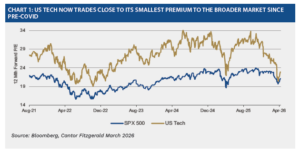
Recent market dislocation, juxtaposed with an acceleration in earnings growth, has led to a broader de‑rating of equity markets. This has been particularly pronounced in US tech, which now trades at its smallest premium to the wider market since the pre‑Covid era; however with free cash flow yields declining and a winner‑takes‑most dynamic prevalent in AI, disciplined stock selection remains key. Furthermore, a broadening of the US equity rally appears likely due to pro‑cyclical fiscal policy, deregulation combined with an incremental economic tailwind from the FIFA World Cup.
For Europe, the energy shock, whilst significant, has proven less severe than that wrought by Russia’s invasion of Ukraine in 2022. In the short term it will serve to slow the pace of recovery in manufacturing; however, on a more medium‑term view, it can act to galvanise European leaders to boost fiscal spending on both defence and energy independence. For China, the economy has started the Year of the Horse on a firmer footing with export growth accelerating alongside tentative signs of a consumer recovery. A summit next month between President Xi and Trump should provide greater certainty on the two nations’ trading relationship and support sentiment going forward. Emerging markets more broadly are well positioned to offer opportunities in the coming months underpinned by robust earnings growth, attractive valuations and diversification benefits spanning commodity‑rich Brazil to technology leaders such as South Korea.
In fixed income, whilst markets moved swiftly to price in a tightening of monetary policy following the outbreak of the conflict in Iran, medium‑term inflation expectations remain well anchored. With global central bankers generally viewing recent price spikes as transitory, now may represent a compelling opportunity to lock in attractive yields in short‑to‑medium‑term duration debt. Income can also be generated from alternatives such as infrastructure, an asset class whose centrality to the scaling of AI comes second only to coding prowess.
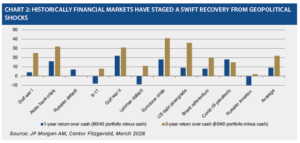
Overall, whilst the current environment may feel unnerving, history teaches us that geopolitical shocks to financial markets are typically short lived. As a result, staying invested in a diversified strategy aligned with your risk profile and financial objectives will leave you best placed to navigate the challenges and capitalise on the opportunities on offer in the months ahead.
Written by John Mullane, CIO, Cantor Fitzgerald Ireland