



The Weekly Compass 30/03/26
 John Mullane
30.03.2026
The Weekly Compass: 30/3/2026
Our CIO, John Mullane, shares the latest Market News and Views and gives insights for the week ahead: Ongoing Iran conflict puts spotlight on inflation in week ahead
The Week that Was
Global equity markets trended lower last week as fears of stagflation weighed on investor sentiment as the war in Iran continued for its fourth week. The S&P 500 fell 2.1% on the week with large-cap tech underperforming and pushing the Nasdaq into correction territory.
European equities moved 0.6% higher, buoyed by a strong rally in the chemicals sector where tightening supply due to disruption in the Middle East can act as a price tailwind. Global Commodities climbed 0.5%, supported by continued strength in oil prices and a rebound in precious metals. Global Bonds moved modestly lower, with the US/German 10-year finishing the week at 4.43% and 3.09% respectively.
The Week Ahead
Markets in the Asia-Pacific moved lower this morning as the war in Iran entered its fifth week and Japan threatened to intervene to prop up its currency. The yen currently stands close to levels that have triggered previous interventions to dampen inflation. Brent has climbed back to $115 a barrel as the Houthi Rebels have threatened to target the Bab al‑Mandab strait in the Red Sea, a chokepoint which could further reduce the amount of seaborne oil leaving the Gulf region.
European gas prices are also trending higher as Russia, which accounts for c.12% of European gas supply, is proposing to halt exports from April 1st due to domestic shortages.
In what is a holiday‑shortened week, developments in Iran will continue to be the key driver of market sentiment. President Trump has noted the US has only 3,000 targets left of an initial 16,000 and that a deal with Iran could be reached ‘soon’. Nonetheless, the market has become unnerved by the US’s decision to deploy up to 10,000 troops to the Middle East. This is likely a show of strength to put pressure on Iran in negotiations and/or to carry out a targeted operation to extract its uranium as the number of troops falls well short of what was committed to previous large-scale ground invasions (e.g. Iraq in 2003: 160K troops and the Gulf War in 1991: 670K troops).
Clearly, the current environment remains unsettling for investors; the market impact of similar geopolitical events, however, has historically been short-lived. Any signs of de-escalation will provide opportunities for investors, particularly in areas such as the US technology sector, which has de-rated significantly since the start of the year, leaving its forward P/E premium vs. the S&P 500 back to levels last seen in 2019.
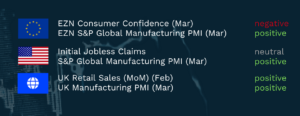
Macro updates will be the other main focus for investors in the week ahead, particularly as the earnings calendar is very light. On Tuesday, Eurozone inflation data for March will garner plenty of attention, with the headline rate expected to climb to 2.5% from just 1.9% in February on the back of rising fuel prices. With core inflation expected to rise only modestly and ECB commentary mixed, market pricing of two rate hikes this year looks premature.
In the US, consumer confidence for March is likely to provide evidence that higher gas prices are weighing on sentiment and putting pressure on Republicans, whose prospects of success in the mid-term elections are darkening. On Wednesday, ISM data is expected to point to the resilience of the US manufacturing sector in March as it benefits from re‑industrialisation.
Finally, with US markets closed on Friday, March payrolls will have limited immediate market impact; however, a sharp rebound in job creation (55K jobs expected) following a contraction in February is encouraging.
This is an extract from the Weekly Markets Report by Cantor Fitzgerald Ireland. For more detail on individual securities, or to discuss how we can support your investment needs, please get in touch.
Written by John Mullane, CIO, Cantor Fitzgerald Ireland