


Inside the Terminal: Our Interns Visit Bloomberg's Dublin Office
Every summer we try to give our interns more than desk experience. We want them to see how the wider industry operates and to meet the people and platforms that shape modern investment markets. Mornings like this do double duty. Interns walk away with a real, checkable skill for their CV and a much clearer sense of what a career in markets actually involves day to day, rather than the version they’ve picked up from lectures or textbooks. For us, it means a cohort that is faster to onboard if they return as graduates or analysts, and it shows the wider market, our clients and future applicants alike, that we take developing talent seriously rather than treating an internship as a summer of admin. It’s also a valuable morning for us as a firm, since Bloomberg is a partner we rely on daily and time spent building that relationship pays off in stronger support down the line.
On the 2nd of July our twelve summer interns visited Bloomberg’s Dublin office for a morning dedicated to the Terminal and its role in global markets.
Below, in his own words, intern Kanishk Kumar shares what the day was like.
In their own words: a morning at Bloomberg
By Kanishk Kumar, Finance Intern
As part of our internship with Cantor Fitzgerald Ireland, the other eleven interns and I spent the morning of 2 July at Bloomberg’s Dublin office, learning about the Terminal and the part it plays in the global investment industry.
After a short walk from our office on St. Stephen’s Green, we arrived at Bloomberg, collected our visitor passes and enjoyed breakfast before the session began. We were welcomed by Vicki Leong, UK and Ireland Account Manager at Bloomberg, who led the session and gave us a great introduction to the Bloomberg ecosystem. Throughout the morning, she showed us how the Terminal is used across research, trading, portfolio management and risk analysis, and the session stayed interactive throughout, so we got to ask questions and build a practical understanding of the platform along the way.
We started with DES, which gives a full overview of a security’s key financial and market data, then moved on to YAS to look at bond pricing, yield calculations and fixed income analytics. One section felt particularly relevant given the portfolio competition currently running across our cohort: PRTU, or Portfolio and Risk Analytics, where Vicki recreated a multi-asset portfolio and showed us how investors build, monitor and analyse portfolios in real time.
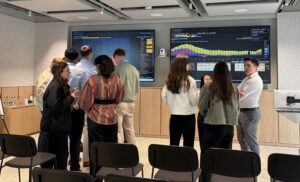
From there we explored Launchpad, Bloomberg’s customisable workspace tool, followed by GP for interactive charting and the Terminal’s real time news feeds, which track market moving events and earnings as they happen. The session then turned to research and intelligence. Vicki introduced us to Bloomberg Intelligence and its proprietary research on companies and sectors, SPLC and how it maps supply chain relationships and the disruptions that ripple through them, and OILS, which tracks global energy markets, shipping activity and commodity flows.
One of the highlights for me was ASKB, Bloomberg’s AI powered assistant. It showed us how investors can use natural language prompts to pull up relevant research and data in seconds rather than searching manually, and it gave us a real sense of where artificial intelligence is heading within investment workflows.
To close things out, Vicki walked us through Bloomberg Query Language, which is used to extract and analyse large datasets, and BQuant, Bloomberg’s Python based research environment for quantitative analysis and modelling. We also learned about Bloomberg Market Concepts, the platform’s globally recognised certification programme, and the HELP function that connects users directly to Bloomberg’s support team. The morning wrapped up with a Q&A where we got to talk careers in financial markets, industry trends and where the profession is heading.
On behalf of all the interns, thank you to Vicki Leong and everyone at Bloomberg for hosting us. It was a genuinely useful morning that deepened our understanding of the Terminal and gave us a real appreciation for how much innovation sits behind modern financial markets.